Tuesday, April 24, 2012

Thawing Out from the Winter

4/24/12

Sea lion buddy looking for handouts
I'm sitting in Blue Bossa at the port of Petersburg, listening to my sea lion buddy snurf and sputter near the transom of my boat looking for fish.  He is as easily big as the local Santa Cruz harbor sea lion, and just as fat and happy.  But unlike California sea lions, he doesn't bark. Just makes a lot of funny noises.  The sun is shining through the rain clouds, the rain being intermittent today, while yesterday (Sunday) it was totally sunny. I spent a good time yesterday walking the streets of Petersburg and along the shoreline, enjoying the view and stretching out my legs.  There's nothing nicer than Alaska with sunshine.

Super low tide and beautiful day at Petersburg
Petersburg is a much more "civilized" town than Wrangell.  It is known as "Alaska's Little Norway" and has a ton of history starting with a bunch of Norwegians starting the town in 1910.  There are lots of buildings that are built with a certain northern European flare, and plenty of things, such as Norwegian flags and even a mini-viking ship on display to remind everyone that. All aspects of Petersburg has been oriented towards the fishing industry, with a couple of big processing plants in the town, and a huge fishing fleet.  I stopped briefly at Petersburg last year, but didn't get a chance to really know it.  The reason why I'm in Petersburg now is to solve a couple of issues on my boat, but I'm also happy to explore a bit more of this small town. I may even rent a car to explore the island later this week.
Petersburg's huge fishing fleet, waiting for the season to start


Petersburg's Viking ship (boat)


Petersburg looking north


The local Coast Guard


An unwrapped Blue Bossa (cover off)
Wrangell - my storage was at the blue arrowhead towards the bottom
So lets go back a couple of weeks:  I landed in Wrangell after having spent the last 6 months in "The Lower 48", spending most of my time in Santa Cruz, where I happily played a lot of music with lots of gigs and enjoyed the mostly sunny weather.  But by the time April came around, I was feeling antsy and ready to get back on Blue Bossa. During those winter months, I had a guy checking on the boat once a week to make sure that the boat cover was still on, that all of the fans and air-dryer heaters were working, that the boat was nice and dry, and that the bilges were empty. He mentioned that often he would have to go around the boat to push the snow or rain water out of the pockets of the saggy boat cover, but, other than that, there were no issues.  When I arrived in Wrangell, the town was right in the throes of reconstruction of their entire main street in the middle of town, making it dusty, noisy and irritating.  I'm sure, to the shops along the street, it has been hell. 

About to get hoisted out of the water
Wrangell is a quirky town and reminds me of a typical Mexican village, with it's run-down looking shops, dirt streets, and, when it's not raining, dust all over the place.  I'm sure when they get the street completed (exasperated folks are telling me that it'll never get completed), it will be a much better looking town.  Shops (including the market) all close on Sundays, and the Harbor Master's office is closed both Saturday and Sunday. It's not a strong work ethic, but the people are pretty friendly.

The guy controlling this contraption has the green shirt

Easy does it...
Pressure washing the bottom
Perched on stands
Get on board by the two ladders
No zinc!
The first thing I did was to get the boat hauled out.  Since the boat yard is city-owned (along with all of the marinas), I mostly dealt with the harbor master who is responsible for hauling out boats, mounting them on stands, and then launching them back in the water when the jobs are done. To get any labor done, I contracted out to a local service agent, who got the necessary manpower to spray off the gunk on the bottom, to tape off the boat, and then to spray on the new bottom coat.  I had purchased 3 gallons of bottom paint from West Marine, but found that I needed another gallon.  The first 3 gallons were a light blue, and the only bottom paint that I found that matched the


contents of the 3 gallons was the color of brick red.  So I ended up with a gunmetal blue bottom, which looked kind of cool.  I also found, to my consternation, that the zincs, fastened to the transom of my boat, had almost completely dissolved. A zinc, for those who don't know, is used to "sacrifice" itself from metal-eating electrolysis, caused by being in a saline solution (salt water) with two or more dissimilar metals, causing the weaker metal to start falling apart. Luckily, this mishap had not caused any corrosion that I could see, so I replaced the zincs. 

All clean, taped and covered for the bottom spray job


I also had the pleasure to put some epoxy "SplashZone" on the bottom of my keel where I had run into some rocks last year.  The stuff is super sticky and hard to work with unless you have some water to mix the 2-part stuff with...you mix it with your hands and it's like Play Dough.  With water you smooth it out and then let it dry.  Once it's dry, it's harder than steel, and just about as hard to sand.  Really good stuff!

A word about the Wrangell boatyard: this boatyard is the biggest and best yard in the panhandle, so a lot of fishing boats from all over come to get hauled out.  It has become so popular that a good chunk of the Wrangell economy is based on the boat yard. The city is investing in another travel-lift.  The one they have can lift boats up to 150 tons.  The one they'll get next year will handle 250 tons.  To give you an idea of size, my boat weighs 11 tons. The operator of the lift (who could control it with a remote control device slung around his neck), figures that they'll be able to haul out boats up to 150' long or more.  Since the boatyard is so popular, it took me almost a week to get everything done that I needed done while it was out, because everyone was so busy.

Spray painting the custom-colored bottom paint
Once I was back in the water (thankfully no mishaps or accidents), I spent a good week de-winterizing the boat, putting the jib back on, moving the dinghy and outboard on the davits, putting the paddle board and kayak back in their rightful spots.  Then I got into some mechanics by replacing the water heater and waste tank macerator, both jobs requiring yoga-style contortions to get into the tight places, something my old and out-of-shape body has a hard time doing.  Nonetheless, it got done and it all works fine; it's nice to have some hot water on demand. However, my navigation instruments (speed, depth, windspeed, and, most important, autopilot), which are all connected as a network, refused to work, even after exploring the boat's electrical system, which is very complicated.  I decided that I needed some professional help and found that Petersburg had a few businesses that could help. 

Wrangell Narrows
I figured I better haul-ass to Petersburg before a big front was suppose to land the next day, so I took off, planning on timing the tides so that I could get through the Wrangell Narrows without bucking against any current.  I ended up about an hour and a half late at the entrance, but, as it turned out, I couldn't have timed it more perfectly, and by the time I was in Petersburg by 3pm, the sun was out and shining.  I was guided easily through the Wrangell narrows with the help of a great buoy system marking the channels, and the use of my GPS map in my computer.  I didn't need a depth sounder, though I would have felt more secure with one on.

So now I've located a guy to work on my instruments and we have been able to find that it was caused by a corroded link cable in the cockpit, which the tech has ordered from B & G in the east coast.  Hopefully he'll get it soon and we can install it. I also dropped off my Honda outboard to a service repair center for servicing, cleaning it up, and trying to find out why the damn thing isn't working.  It's probably because of a corroded wire somewhere in it's complicated insides.

Oh well, such are boats, a hole in the water to pour money.  And effort.  And time.  And lots of thought.

Going north in Wrangell Narrows

Wednesday, November 9, 2011

Road Trip!

Utah Salt-flats - about as flat as you can get
11/9/11

I’m sitting in an auto glass shop in Santa Cruz waiting for them to finish replacing my cracked windshield of my “Nubaru” that I acquired specifically for my road trip in October.  The lady said it was going to take all day.  Argh!  No other means of transportation to get back to the house that I’m sharing with a couple of other people.  But, what the hell, it gives me an opportunity to plunk out this little intermediate blog about my road trip that I haven’t had an opportunity to do before (update:actually, they were able finish by noon, so I finished this blog later that day).
Zombie badger at Bill & Bird's rental in NH


Black Canyon in Colorado
My idea was that instead of flying to Boston and renting a car to drive up to New Hampshire, I would buy a car in Bend (no sales tax, plus my “mailing address” is at Rick and Chris’s house), drive to Santa Cruz for Andy and Allison’s big Fall party, then drive to the east coast.  Driving cross-country was always something that I wanted to do but never got around doing…it has always been on my bucket list on things to do.

Looking down at the rapids of Gunnison River
Initially I was going to try and find a used Subaru (or VW Jetta diesel, if I could find one), but there was nothing good available without a lot of waiting, searching, and time.  So, even though I swore I wouldn’t do it again, I bought a new car. And since I’ve lately been into retro things, I got one with a stick shift. So far, I don’t regret the stick shift, but I’m glad I’m not commuting in heavy traffic to go to work. :>)

My road trip took about 3 weeks.  I took the northern route going east, and the southern route going west.  Highway 80 was the main way going east (with lots of diversions off the beaten path), and Highway 40 (Route 66) was the main way going west (also with diversions).

Wind generators aplenty in Utah going into the Rockies
Instead of boring everyone about my road trip, I thought I’d spell out some of the highlights and my observations, in roughly chronological order.

Music:  during my old college years when I and a bunch of friends would take road trips in my old VW van and creep from Colorado to LA listening to old Stones albums and anything that we could get a tape to listen.  So before the trip started, I collected a bunch of digital tracks of familiar (to me) 60’s and 70’s music on my iPod so I could listen to them, as well as all of my varied jazz collection.  Between this and catching NPR on the radio in various parts of the country kept me well entertained and energized.

Lots and lots and lots of corn fields
Corn: most of the open fields that were not desert or high altitudes were fields and fields of corn. It’s easy to see that this is the US’s main cash crop, what with all of the higher percentages of ethanol that we’re seeing in our gas nowadays.

Looking west from the continental divide - middle of the Rockies
Wind generators: I was very happy to see that, in most places that were wide open, or had a lot of winds, there were more wind generators than I have ever seen before.  To me, wind generators are not an eyesore, if only because they represented a much cleaner source of energy than the local propane or coal-driven energy plant. I used to buy wind generators for West Marine (electrical department); the style very much reflected what I was seeing on the road, except the ones on the road were 4-5 stories high, and each blade would be 30-40 feet long.  Yikes!

Gas prices:  talk about variation - from almost $4/gallon in California to almost as low as $3/gallon in the east coast.  You have to wonder why!  My Nubaru is not like my old Prius – instead of 45-50g/mile, I averaged about 28 to 30.  I’m spoiled.

Looking at Colorado Springs from Pike's Peak
Switch-backs on Pike's Peak
Continental Divide:  the Rockies are really amazing.  I went to Colorado College for a couple of years, and I don’t remember grasping the subtlety of this mountain range.  It’s not dramatic craggy mountains like I see in Alaska or even the Sierras.  It’s just this giant, rounded ridge that gets higher and higher towards the middle with relatively unassuming peaks around it.  It’s only until you realize that you’re 10,000 feet up that you realize that you’re in a mountain range.  Despite it being undramatic, the Rockies were undeniably beautiful.  When I was driving south of Hwy 80 on two lane highways I was reminded of the trips that I used to do driving to Breckinridge (playing music for ski tickets and room & board) during the winter in my old Scout, and the wide open snowy valleys with a minimal amount of trees and giant, fenced ranches.  It felt like that now, except instead of the fields covered with snow, it was a beautiful green and yellow grass.

Looking up at Pikes Peak - notice the yellow leaves
Black Canyon of the Gunnison, Colorado: obviously not as breathtaking as the Grand Canyon, it still represented a more intimate connection on how the earth is shaped by water, as well as by plate pressures and glaciers.  It is also more dramatic at how steep the cliffs are. What was cool about it was that I could see the Gunnison River, a well-known and difficult river rafting/kayaking challenge, flow underneath my feet very clearly.  It’s also interesting to note that in both the Grand and Black Canyon, getting there requires going up several thousand feet.  It’s like building a big sand mound on the beach and taking a stick to create a deep path through it, the stick being trillions of gallons of water flow a year creating a deeper and deeper gouge. 

Pikes Peak Lake
Pikes Peak:  I’ve been up it once before, when I was going to Colorado College – I and some friends took my old VW van and went up it’s steep, switchback road all the way to the top at 14,000 feet.  The old van barely made it up, having to keep it in 1st gear the last quarter of the trip.  Going up with the Nubaru was easier, but I still often had to put it in 1st gear to come out of one of its many hairpin turns.  On top, the view is breath taking – easy to do when you’re that high.  My breath was taken as soon as I started walking around, feeling my heart beat a little harder, and taking slower steps and having to breathe deeper.  I felt like an old man up there.  Hmmm…

Mist and rainbows at Niagara Falls
6 million cubic feet per minute!


Colorado College:  Colorado Springs has grown unbelievably from a relatively small town to a metropolis as big as Pasadena, it felt like.  There were lots of traffic, the freeway going north and south had grown lanes, and suburbia looked like it has spread out quite some distance, both north and south.  I hadn’t checked it out, but I bet that there is little difference in housing between Colorado Springs and its neighbor to the south Pueblo.  The college, however, was the same…same buildings, beautifully manicured lawns, and same trees shading the streets.  The college still has the block system that they started just after I left the school.  In retrospect, I regret having left that college as it would have been nice to experience taking one class over a 3 week time, concentrating only on that class.  Well, I’m sure (surf) that I (surf) had my (surf) reasons…
Many rivers head to Niagara Falls
Niagara on top


On the Canada side
Hand made just for the Adirondaks
Niagara Falls: easily the most awesome display of water flow that I’ve ever seen, including waterfalls in Alaska. It literally dumps the water from Lake Erie to Lake Ontario, the two lakes separated by a super wide river that seemed to come from everywhere. The Lake Ontario basin, sculpted by glaciers a kajillion years ago, looked like a giant drain sucking in all of this water, making a lot of noise.  I happened to be there on a nice sunny day, so the mist coming up, creating myriads of rainbows, brought in a whole lot more colors beside the greenery surrounding the waterfalls.  The combined water flowing into Lake Ontario is more than any other waterfall in the world (6 million cubic feet every minute!).  It was impossible to take pictures showing the whole grand concept.  One of these days, I’ll have to figure out how to take large landscape pictures – but you should check out http://en.wikipedia.org/wiki/Niagara_Falls.  On the U.S side, there was a ton of tourists looking – almost all of them were from China, Korea, or Japan, although some from Europe.  I also drove across the bridge to the Canada side (the border guard gave me a big hassle because I didn’t have any license plate on my Nubaru).  On the other side, the mist from the waterfalls inundated the streets of the town next to the waterfalls, making the streets all wet, and people wearing waterproof ponchos. 
Lake Placid

Typical Maine lobster boat on the hard
Upper state New York: I have pushed through New York City plenty of times, mostly going down the coast from Boston to Annapolis on various boat-show related activities and trying to figure out how to get past the ever-present traffic gridlock.  But I have never truly visited the beauty of New England during the fall; it is inspiring. There was certainly an orange and yellow color scheme going on there, especially while traveling through the Adirondack Mountains in the northeastern part of New York state.  Although the elevation on the road didn’t go a whole lot past 3000 feet (5,300 is its highest mountain peak), the mountain range is north enough to get a fair amount of snow during the winter.  Lake Placid hosted the winter Olympics in 1932 and in 1980, so all of the motels and hotels had some sort of reference to the Olympics, especially hockey, where in 1980 the US team beat the USSR team for the gold medal.  It’s also well known for the skiing (at least on the East Coast), but I have to think that the masses of wannabe skiers coming up from NY City to ski would make the place uninhabitable. 
House where Joel and Robyn got married
Maine: was as expected, beautiful, but hard to really explore on the road.  I would have much preferred to be out on the waters discovering the plentiful nooks and crannies not accessible by road.  That could well be a goal on my bucket list in the future.  I stayed a couple of nights at Bar Harbor, which was overrun by tourists all coming from…are you ready?...cruise ships!!  Gagh!  I can’t get away from them!
Joel and Robyn’s marriage: beautiful ceremony with thought-provoking marriage declarations, magnificent yet quirky house on a prime waterfront New Hampshire property, lots of friends and relatives with a reviewing of old relations and discovery of new – all that and more merged to become a very memorable event.  I’m really glad I came.  Thank you Robyn and Joel for inviting me!
Apropos name at the marriage property


North Texas suburb
Motels and hotels: been there, done that.  I don’t have any desire to go to any more motels and hotels.  Despite giant differences in pricing, they smell the same; they almost always look the same and always with some kind of forced air pushing in.  Say, here’s an idea: tow a small teardrop mini trailer and use it for camping.  They are relatively cheap if you buy used, they don’t weigh more than 800-1000 pounds, and my Nubaru (jeeze, I’m going to have to call it a Subaru now, it’s got more than 10,000 miles on it now) can tow one easily.  While I was driving I noticed that there were a lot of camping spots, some in absolutely gorgeous surroundings. With more time to do exploring, I could spend a whole summer visiting different places in US, Canada or even Mexico and not have to spend another god-awful night in some stinky motel.  Hmm…it’s something to think about.

Grand Canyon
Religion: I noticed driving the southern route back to California that there were numerous roadside signs advertising different religious groups.  My friend Andy reminded me that the “bible-belt” takes up a huge part of the US, especially on the south side.  It was certainly evident even driving the highways, especially the mega-chapels that I saw driving through Tennessee and Arkansas.  Wow!  Big mansions, only differentiated from other giant mansions by having a steeple placed in some part of the structure, were dotted along the highway. “Here is the church, here is the steeple, open the doors and see all of the people”.  I could only envision a lot of money pouring in from lots of people supporting these rich organizations.  While driving through a city, I would scan my radio for NPR and hit bunches of religious stations, all with some sort of hell & damnation theme and quotes from the bible. Without making any “politically incorrect” personal observations (I’ll leave that up to Bill Mayer), I would simply say that social culture sure varies wildly from state to state.
Rest Stops:  these varied wildly from state to state.  I thought that California rest stops were pretty fancy until I saw some of the northern ones that had a travel center, restaurants, gas stations, etc.  I guess it’s how much money a state is willing to spend on that kind of stuff.  With the economy in the tank for the states as well as the U.S., those kinds of things will be bypassed I’m sure.
Me, after staring at the Grand Canyon all day...
Grand Canyon: this was the 3rd time in my life that I visited it.  It’s worth it every time; but the grandeur of the place is so great that you often don’t see any of the smaller details that can be missed if you don’t sit down and stare out - which is what I did this time.  I was at the canyon almost the whole day, hiking around from viewpoint to viewpoint, but mostly finding a good comfortable spot, sitting on my ass and staring – trying to see small details.  Thankfully the weather was beautiful, and I left with a strong color sense of orange/brown in my head.  Perhaps one of these days I will go down the Colorado River to see the Grand Canyon from below.  I wonder if it will be just as majestic.
Missed opportunities: on my way back to California, I was “smelling the barn”, looking forward to playing music with friends or on gigs, so I bypassed a few places that I thought about visiting, but am now looking forward to visiting if ever I got the chance to travel again:  New York for the jazz clubs, New Orleans for the same reason, Oak Creek Canyon in Arizona where my mom took us 3 boys to visit on a familial road trip during one summer – and basically taking some more time to smell the roses. Also, it would be fun to have a kayak or paddleboard with me, while visiting the various waterways that I saw.
California desert driving
Now I’m in Santa Cruz, sharing a house with another couple, and soon to move to a small studio, only a few steps away from Pleasure Point.  It’s been tough getting back to surfing, trying to acclimate my muscles and joints (bad shoulders) and my sore ribs, as well as getting up fast enough on the board to not wipe out all of the time.  But playing music has been fun, and I already have at least 3 gigs a week, so that’s been exciting.  Fortunately (or unfortunately) my travel bug is still alive and well, and I may go on another trip – maybe to New Zealand as I threatened to do in my earlier blogs.  I haven’t figured it out that far.  I still have a lot of projects that need getting done here, including a complete health checkup.
Blue Bossa is still up in Wrangell, awaiting my return.  The guy who is taking care of it says the only problem is the cover on the stern – since it’s not fitting very well up there, it collects water in the pockets formed by the misfit, and when it gets cold, will turn into ice.  He has to pop out the water or ice every time he visits the boat. But everything else is fine.  I may fly up there after Christmas to see for myself and run the engine, but the flight costs are pretty high.  We’ll see.

Tuesday, September 13, 2011

Sitka to Wrangell

9/13/11

Well here I am in Wrangell’s Sourdough Inn.  A very nice place, very quiet and it has WiFi.  I think I'm the only guest in this lodge. I'm watching this huge screen TV, which is where the WiFi is.

I just spent the last two days “winterizing” Blue Bossa.  First I cleaned it – galley, head, floors, and rugs.  Then I put the kayak and paddleboard on the roof of the pilothouse.  Then I pulled the outboard off of the dinghy and put it on its bracket in the stern.  Then I put the dinghy on the forward deck, bottom up. Then pumped all of the fresh water out and put in special (ie: potable) antifreeze in the fresh water lines.  Then closed all of the thru hulls except the engine intake valve.  Then opening all of the cabinets and bunks to get maximum amount of air circulation, then putting out a couple of 110v fans and a couple of electric dehumidifiers in strategic places on the boat. 
Cover looks good except the back...

Oh yeah, and putting the cover on the boat was a real treat: it came in 4 pieces, and figuring out where what goes where was like trying to solve a jigsaw puzzle without the picture.  Luckily I have prior experience putting the cover on the Siwash, which is also a very complicated set-up, so after laying each piece out on the dock I was able to figure how to put it all together.  It was an original cover made for the boat 12 years ago, before all the crap that was built up from the previous owner and myself on the stern – so it fit fine in the bow, but looked like scrambled eggs in the stern.  Hopefully I have plenty of line set up to hold the cover tight on the stern so that it doesn’t all come apart.

It was a real adventure getting here from Sitka.  On 8/29 we filled up with fuel, left Sitka about 2pm and went outside, heading for the outside coast of Baranof Island.  It was smooth seas with a 3ft swell to Samsing Cove.  Samsing Cove was very pleasant, landlocked and very quiet.  Inside was a fishing boat tied to a buoy further up the cove, but it left shortly, leaving the cove to myself for the night.

Singsam Cove
West coast of Baranof, heading towards the Rakof Islands
landing on Goddard Hot Springs
The shack
The view
The happy customer
The place
The next day we left Samsing to head to Herring Bay.  Winds were light out of the west, cloudy skies, and no rain.  Blue Bossa did a lot of twisting and turning around islands and rocks until we worked into Herring Bay and dropped an anchor, wind coming out of the north.  I launched the dinghy and, bringing a bathing suit, zipped out of the bay, headed east to Dorothy Narrows and headed north to Goddard Hot Springs, where there was a small shack and a place to land the dinghy.  Grabbing my bag, I walked the small boardwalk to the shack, which inside was a large round hot tub with a faucet to let in hot water.  It had a nice view from its window (no glass) of Kliuchevoi Bay with a lone ketch at anchor.  It isn’t as good an anchorage as Herring Bay, but, because it was calm, it looked good enough.  Anyway, the tub felt fantastic and I soaked in it for about a half hour before taking my shriveled body out. I pushed the dinghy back in the water and explored around until I ended back on BB.

BB in Herring Bay
The next day - 8/31 – we left Herring Bay at about 10, wormed our way around a bunch of islands and then shot through 1st narrows, which brought me into the Rakof Islands, then squeezed through a narrow entrance to Baidarka Cove. It was like I was cheating the outside ocean, staying under the protection of these little islands and passages while still being out on the west coast of Baranof. The last 3 days had no rain and even some sun, but today, it started raining hard at about 5pm.  Weather forecast promised heavy rain and wind for the next 4 days. Yikes!  It rained and blew hard that night as promised.

The next day it was calmer and, with a high tide, I left Baidarka Cove.  We weaved thru the second narrows and went up the middle channel, which was rough because of the SE wind. There was no more free rides (protection from chains of islands) from the outside. We wound through yet another narrow pass called Cameron Pass then dipped into Scow Bay, on Beauchamp Island. Scow Bay is a bombproof anchorage separated from the Gulf of Alaska by just a few low-lying islets and rocks.  It was raining, so I didn’t do much except read.
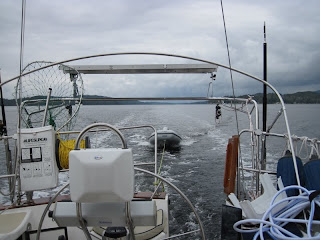
Cruisn' the Raka Islands
Scow Cove
The next day I decided that there was enough of a window to slam against some 20k southeasterlies to make further south and anchor at Still Harbor, where I figured I would stay for a few days, as the forecast promised very high winds for the weekend.  It was a lumpy as well as a windy ride, but do-able.  It was a 3-hour bash.  Still Harbor was more picturesque than Scow Bay, and was very quiet and calm.  Since it was on Baranof Island and had a creek running into it, I was hoping that I would see some bears.  I actually did see a bear on shore the next day – he/she was looking for tidbits on the medium tide shore, pushing over large rocks to find goodies.  I rushed down to get my camera and tripod, but when I put my head back up, the bear was gone.  Darn!

By Labor Day, I was still waiting for the storm to hit – the weather forecast said that it was going to hit that night – gale to storm force winds - waves were suppose to be 18 feet and winds over 40 knots.  I was skeptical - I’ve already read two books and was on my third – I was bored and ready to move on, but I had to sit this one out. 
Baidarka Bay

That night, I almost lost my boat. 

The wind started to come up just when it was getting dark, the boat tacking back and forth on the anchor.  I was feeling pretty secure, thinking that the bottom was muddy and that the boat wouldn’t drag.  That feeling went down the drain in a hurry.  About 10pm, the anchor chain started making grinding noises, usually made when rubbing against rocks or boulders, the boat jerking.  Knowing that there shouldn’t be any rocks where I was anchored, I instantly became alarmed, looking futilely out in total pitch darkness with driving rain.  Since I couldn’t know where I was by looking out, I turned on the computer chart.  I was shocked to find that Blue Bossa was yards away from going aground on a small rocky island 100’s of yards where we were originally anchored!  Holy Shit!  I turned on the engine and headed into the wind, taking some of the strain off of the anchor. 

Scow Cove
I was in a very bad situation and needed to get out of it and the only way to do that was to raise the anchor.  Normally when I pull the anchor up, I'm on the bow pushing the buttons to raise the anchor, while the engine is just idling.  But the wind was blowing 30-40 knots - no way was the windlass going to pull the anchor up unless I took off the strain by using the engine at the same time raising the anchor. Even if the windlass could pull up the anchor by itself, as soon as the anchor was off the ground, the boat would go hurtling towards shore before I could get to the pilothouse and maneuver out of that situation.  Which meant that I had to stay in the pilothouse to maneuver the engine and the boat while pressing the remote anchor windlass switch in the pilothouse.  Plus I also had to keep the engine revved up enough to supply extra electricity for the batteries. At the same time, I had to keep the boat into the wind and the only way I knew where I was heading was looking at the chart and looking at the radar. 

It took me a good half hour to finally get the anchor up, multi-tasking, sweating and swearing the whole time, looking at the depth sounder, which ranged from 49 ft to 6 ft., the boat tacking back and forth while I’m madly struggling to keep the boat into the wind while lifting the anchor up, constantly adjusting the throttle and trying to keep the RPMs up.  Argh!  It would have been a challenge with another crewmember in the bow – now it was an almost impossible task.  Thankfully all of the boat’s systems were working!

Still Harbor - when it was still
Finally the wonderful sound of the anchor hitting the pulpit informed me that I now had to work my way back up the bay in safer waters.  Still in pitch black, heavy rain, and 40 knot gusts, and working only on the radar, chart plotter, and depthsounder, BB made her slow way back up the bay, still tacking back and forth, me struggling with the wheel to correct (using only radar to figure out where you are makes it easy to over-steer), until it looked like the right place to anchor.  I let the anchor hurtle down, letting 200’ out.  Once it looked like it set, I revved up the engine to push the boat hard left for a bit of time, trying to move the anchor chain over to the left.  Once there, I ran up the deck and let my Bruce anchor (2nd anchor on my bow) out in a hurry.  When it had set, I now had a V-shaped anchor arrangement, which stabilized the boat from tacking and taking the strain off of just the one anchor and my own peace-of-mind. 

I decided that I would keep my computer on and do an anchor watch until the wind died down.  The barometer started to go back up and the wind started moderating at about midnight and I finally hit the sack about 2am, turning the engine off, which had been generating all that time.  Thankfully, the only damage I got was spraining my shoulder – again.

So my blasé attitude in anchoring almost wrecked my boat in a very out-of-the-way place.  I think I learned my lesson. In forecasted gale/storm force winds, put out another anchor, and put out lots of scope.  Keep the GPS on and set the anchor watch alarm.  Yeah, it takes some juice to run it, but if it’s windy, I’m sure it’ll be useful and I can always turn on the engine to keep the juice up. I actually have an old 2nd generation night vision monocular for dark nights. I didn’t use it that night -  I tried it out the next night and it was really bad – you can hardly see out of it.  I’m glad I wasn’t depending on it.

The next day, it was windy, about 20 knots, and partly cloudy and still blowing out of the south.  The weather report suggested that I stay in the bay, and maybe try for it on Wednesday. But the weather was forecasted to still blow out of the south for the rest of the week through the weekend - so no matter what I would do, it would still be a struggle to keep going south if I ever hope to get to Wrangell. 

Beautiful morning, but still washing machine conditions
So having stayed in Still Harbor for 5 days, with only contacting civilization via my satphone, I decided to take a very small window of opportunity where the wind was less windy to try and make my way south, hopefully far enough to get around the south point of Baranof Island.  So on Wednesday the 7th of September, at 5:30am, we left Still Harbor, passing through the entrance with huge waves on either side (thoughts of the entrance to Morro Bay during the winter), with my engine RPM to 3000, we busted out of the surf area and, when far out enough, proceeded south.  The seas were an absolute washing machine, with waves from the north, west, south, - yes- and east, since the big swells were back-washing against the cliffs of the coast and coming out against the other waves making it totally chaotic.  I had started with a reefed mainsail, but quickly let it out all the way to help try to maintain some semblance of stability, especially since there wasn’t any wind to speak of.  It was so rough that I actually got a little bit seasick, which is really hard considering I didn’t have breakfast.

The south wind came up a little bit but never got over 10 knots; and the further south I went, the less the waves were.  There were a bunch of places that I would have liked to stayed, but I figured I’d better git going while the gittn’ is good. We rounded Cape Ommaney on the south of Baranof, continued south to Cape Decision on the south of Kuiu Island, started heading north to Port Protection, on the north side of the Prince of Wales Island, where we spent the night – an 85 mile trip.

Interestingly enough, the US Coast Guard stopped me.  I was just tying up to a public dock in Port Protection (a very small community of local fishermen), and I heard a couple of guys talking from off my stern, I turn around and there’s about 4 CG men in a big red inflatable waiting for me to finish tying up.  As soon as I was done, they came alongside the dock and wanted to do a safety check to make sure I had all of the proper safety equipment - which they did, being very nice about it.  I checked out fine, except I didn’t have a plaque stating that it was a big fine to pump oil out into the water.  But they forgave that and went along checking out other boats.  Whew!  An interesting finish to a very long day!

During the past week, it had rained so hard that the Stikine River and every other river outlet made it so that no matter which tide I was trying to take, the current was always going against me all the way up through Sumner Strait.  So it took longer than I expected to get to Wrangell the next day.  I found out later that the levels on the Stikine River hit a record high, destroying some property up there and causing some consternation.  All through Wrangell, it was the big talk about the heavy rains.  I also found that – really – this summer was non-existent as far as the locals were concerned – this from many people that I talked to.  So I guess I shouldn’t feel that Alaska is nothing but one giant monsoon.  Hopefully next year will be a much better summer, weatherwise.

I was going to haul my boat out at the Wrangell boat yard and store it on dry land.  But there is heavy construction going on in the yard with new cement and they couldn’t haul out until complete – and who knows when that would be.  There are two harbors in Wrangell.  The first one (Reliance Harbor) I was familiar with – old and kind of grubby.  The 2nd harbor (Heritage Harbor) is new and not quite finished yet (parking lot).  It has brand new docks, all new electrical system, and it’s in a very quiet, very un-exposed breakwater completely surrounding the harbor.  My slip is practically right in the deepest part of the harbor. Plus keeping it there is only about $85/month, not counting electricity – cheaper by far than the storage fees on land.  So that decided me to winter in the water at Wrangell.

Along with double docklines, full cover, and a security guy that will be checking the boat every other week, I think I should be OK.  It’s a bit nerve-racking to be leaving my home for so long, wondering if it will be all right when I get back.  I met a nice couple on a 40’ Willard trawler who, in their younger years traveled on a sailboat 8 years going around the world.  They now live in Wrangell and cruise Alaska during the summer time.  They’ll help keep an eye on my boat too.

So that’s it, folks, for Blue Bossa Blogs for 2011.  I may come out with a piece or two on some adventures that I’m planning on doing this winter, so you should keep checking out the site – I’m going to keep it active, but not put in as much diatribe until I get back to Blue Bossa in early April.  In 2012, I’m planning on taking BB down the coast of Prince of Wales Island (outside), sail south and explore the Queen Charlotte Islands (Haida Guaii), then sail on the west coast of Vancouver Island.  There should be a lot of opportunities for more adventures.